
Voting Systems and STV
A voting system is how voters cast their vote on a ballot paper and then how it is counted, e.g. by marking a cross or numbers.
In elections in the UK the voting system used is dependent on the type of election
First Past The Post (FPTP) is the voting system that is used for UK Parliamentary and Scottish Parliamentary (Constituency) elections where there is only one member to be elected in a consistency.
To vote under FPTP, the voter simply puts a cross in a box next to one candidate that they wish to elect. The candidate with the most votes in the constituency wins.
FPTP is the second most widely used voting system in the world.
Additional Member System (AMS) has been used to elect the regional members in the Scottish Parliament since 1999. This is the "2nd vote" in a Scottish Parliamentary election.
Voters select from a "party list" of candidates drawn up by each of the parties. The voter marks their preference by means of a cross, choosing to vote for a Party/Independent, not usually for an individual. The winning parties then select their members from the "list" of individuals under that party.
After the votes are counted, the proportion of votes that a party has is calculated. Each time a party gains enough votes to be allocated an additional seat, the candidate at the top of its list of candidates is elected.
In Moray, after the Regional (list) votes have been counted, the results are forwarded to the Regional Returning Officer at Highland Council, as Moray is part of the Highlands and Islands region, and the votes are then combined with the rest of the region.
The Single Transferable Vote (STV), was used for the first time for the Local Government elections in May 2007. STV is a form of preferential voting in multi-member constituencies. Preferential voting means that instead of casting a single vote for a single candidate, a voter can express a list of preferences. Votes are made by putting a '1' in the column next to the voter's preferred candidate, a '2' beside their second favourite candidate and so on until they no longer wish to express a preference.
Why is STV used?
It is believed that STV and members elected under this voting system better represents the voter's preferences. Some benefits of using this system include: that give voters a choice of candidates within a party where more than one have stood and because STV lets voters list as many as like they of the candidates in order of choice, they never need to waste their votes or vote tactically. STV also motivates parties to contest all wards and constituencies during an election so they do not only concentrate on marginal seats.
How to complete your Ballot Paper
To understand how STV works, the following example uses an imaginary Council Ward called Taghaidh.
Taghaidgh is a multi-member ward represented by 4 councillors. 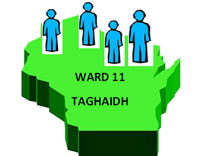
On councillor recently resigned, leading to a by-election for the 1 vacancy or seat.
In this example there are 4 candidates competing for the 1 vacant seat.
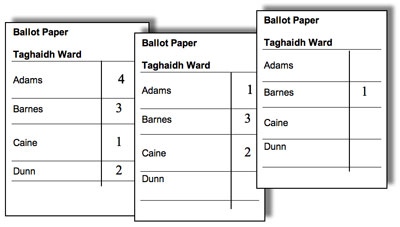
On Polling Day - voters in Taghaidh voted by numbering their candidates in order of preference.
They put a 1 next to their favourite candidate, a 2 next to their second favourite candidate, a 3 by their third, and so on...
Some people chose to number all the candidates; some chose just three or even just one. This is fine, you can number as many or as few as you like.
How is STV counted?
In an STV election, to be elected a candidate must reach a minimum number of votes, called a quota. Any surplus votes are reallocated at a lesser proportion to those in 2nd preference. (i.e. If any candidate does not receive enough support to win a seat, that candidate's votes will be transferred to others according to voters' next preferences)
Scottish Local Government elections are counted using a system called the Weighted Inclusive Gregory Method which is prescribed in legislation.
Votes for multiple seats during a full election are counted by electronic scanner, however, in a local government by-election where only one seat is being contested the votes are counted by hand.
Using the example from the imaginary election above, this is how the votes are counted.
Working out the Quota
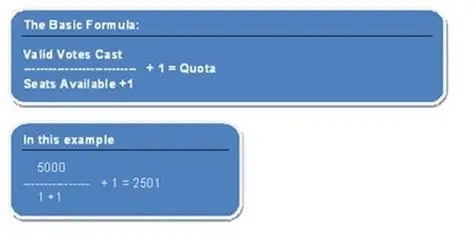
In the example Ward, 5000 people cast valid votes; there is 1 seat available and 4 candidates. Before anything else can happen, the number of votes a candidate needs to be elected must be calculated. This is called the quota.
To calculate the formula we do the following:
Counting the First Preference
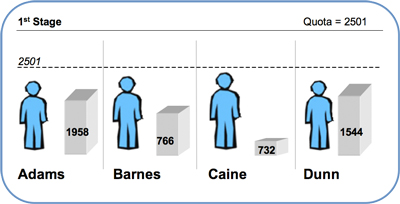
First we count the preference for each of the 4 candidates. Nobody had more than the quota so we move to the 2nd round.
Excluding a Candidate
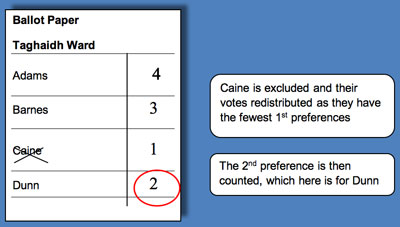
As no-one met the quota, the candidate with the fewest votes at the 1st stage is removed from the count.
In this instance it was Caine.
Caine's votes are then checked again to look for the 2nd preference on the ballot paper, dividing them between the remaining candidates:
The 2nd Stage Results
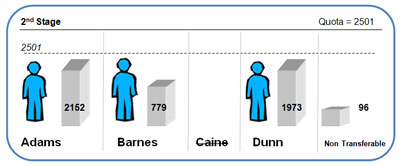
This is how it looks at the end of the 2nd stage.
Of the 732 votes examined, 13 voters indicated a 2nd preference for Barnes, taking the total to 779.
429 voters indicated a 2nd preference for Dunn, taking the total to 1973.
194 voters indicated a 2nd preference for Adams, taking the total to 2152.
96 voters only indicated 1st preference for Caine and made no other mark on their ballot papers, so their papers became 'non-transferrable' at this point.
The 3rd stage
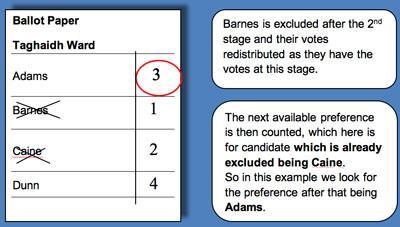
After transferring Caine's 2nd preferences, still no-one had reached the quota. So, once again, we take the candidate with the fewest votes at the 2nd stage and this time it is Barnes.
Barne's votes are then examined to look for the next available preference after Barnes on the ballot paper, dividing them between the remaining candidates.
If the next available preference is for a candidate that has already been excluded, in this example 'Caine' then we look for the next preference after that on that ballot paper.
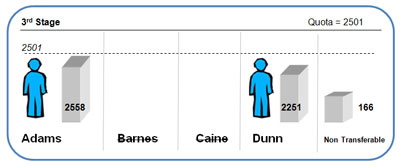
Of the 779 votes examined, 431 voters indicated a 3rd preference for Adams, taking the total to 2583.
278 voters indicated a 3rd preference for Dunn, taking the total to 2251.
70 voters had indicated no further preferences and made no other mark on the ballot papers, so their papers became 'non-transferrable' at this stage, making a total of 166.
Final Results of the Count
After the 3rd stage, Adams received the most votes after the preferences of the excluded candidates were transferred. Adams is now elected to fill the vacant seat.
The number of stages will continue until someone reaches the quota or there are only 2 candidates left and then the one with the most votes is elected.